

Six hours after the opening remarks of the Philadelphia Board of Education meeting on Thursday, Feb. 26, Overbrook resident and former teacher D’Angelo Virgo received his two minutes of testimony.
Over a video call, Virgo made his case against the Facilities Master Plan, which included Overbrook Elementary School as one of twenty Philadelphia schools recommended for closure.
“When we talk about closing schools, we often talk about numbers, budgets, buildings, but we are really talking about displacement,” Virgo said. “We are talking about destabilizing children. We are talking about forcing young people to leave a place where they feel safe, supported, and seen. We owe our students better than that.”
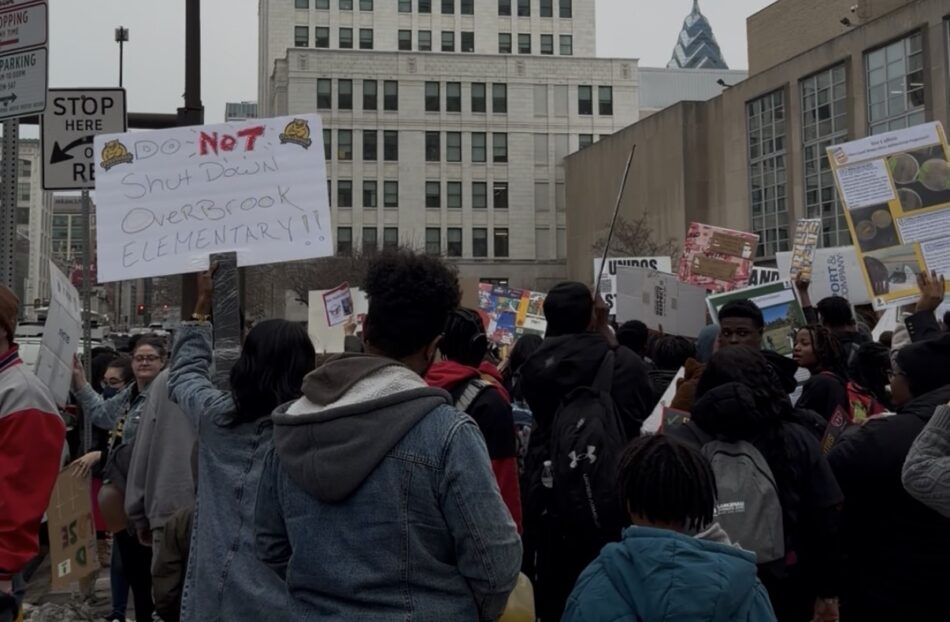
Seven hours earlier, on the steps and sidewalk outside the Dr. Constance E. Clayton Education Center, home of the School District of Philadelphia, a crowd gathered to make their voices heard prior to the meeting.
City councilmembers, local leaders and community advocates took turns speaking to a growing audience on North Broad Street.
“Our schools anchor our neighborhoods, so it is not hyperbole to say that the consequences of the Board of Education’s decision will shape the future of Philly for generations to come,” said District 3 Councilmember Jamie Gauthier.
Swaths of students with homemade banners and signs cheered at the mention of their schools. Passersby honked horns and rang bicycle bells.
“It’s trash, folks. It’s a trash plan,” said Philadelphia AFL-CIO President Daniel Bauder. “They won’t show their work […] How did you come to these conclusions? You can’t show us because you made it up!”
As 4 p.m. approached, the crowd moved inside. The center’s auditorium filled quickly. A seating area with a screen and speakers was set up in the lobby for overflow attendees.
During his opening remarks, Superintendent Dr. Tony B. Watlington took time to explain the reasoning behind the initial proposal, along with the framework for its rollout. He also addressed changes to the initial plan, including the removal of Russell Conwell Middle School and Motivation High School from the original list of schools recommended for closure.
“In an ideal world, I never believe in closing schools,” said Watlington.
“Liar!” a voice from the overflow crowd shouted at the screen.
Watlington explained how enrollment played a large role in deciding how schools were to be categorized in the plan. He shared an anecdote that put his thoughts on the matter into perspective.
“Last week, someone sent me a video and I got a big kick out of watching. It was the graduating [class] at Overbrook High School, the class of 1969,” said Watlington. “I was fascinated to watch this 45-minute movie about a high school that had 5,000 students.”
Watlington clarified he would not recommend returning schools to capacities in the thousands.
Today, the high school has 466 students. Overbrook Elementary, less than a half mile from OHS and one of its primary feeder schools, remains on the recommended closure list.
Before testimonies began, both Watlington and Board President Reginald L. Streater Esq. reminded attendees that there would be no vote held on the plan at the present meeting. The floor then opened to the public.
After 26 students spoke on behalf of their schools, city officials and leaders of local groups and organizations were welcomed to the microphone.
“I want to say: nothing for the people without the say of the people. And the people are saying no to school closures,” said Local 634 President Nicole Hunt. “Listen to us and vote no on the Facilities Master Plan, which is really a school closure plan.”
Five hours after the meeting’s opening, following a 15-minute recess, teachers, school staff and parents were allowed to offer their testimonies. Many speakers made note of the time during their speeches. Many also had the microphone turned off after going beyond their allotted two minutes.
At 10:05 p.m., Virgo began his call regarding Overbrook Elementary. Along with sharing his own godson’s experience at Overbrook, Virgo highlighted how closure would affect Overbrook students who walk to school every day.
“I did the walk myself: from Overbrook to Heston Elementary is about 23 minutes, from Overbrook to Barry is 35 minutes,” said Virgo. “Imagine a six or seven year old making that trip. Imagine winter mornings, rain, snow, busy intersections, traffic. It’s safe to assume none of you would elect to have your children take that walk to and from school […] So why should it be acceptable for ours?”
Virgo ended his testimony with an appeal to the board.
“Choose to tell our young people that they are more than just a number. Choose to tell them that the school is more than just a building. Choose to show them that we owe them better,” Virgo said.
An hour and ten minutes later, at 11:15 p.m., 5th and 6th grade Overbrook Elementary teacher and Overbrook High School alum Debra Joell began her testimony. She wore a shirt covered in student signatures.
“Overbrook Elementary School has been a gem for as long as anyone has ever referred to Overbrook Elementary School,” said Joell.
She brought out a homemade chart displaying differences between math and reading literacy levels at Overbrook and the proposed catchment schools. Once her two minutes was up, Joell’s microphone was turned off.
“Now I’ll use my teacher voice,” Joell said.
She continued, microphone still muted, until she finished showing her statistics.
The meeting ended at 12:15 a.m. Again, Streater reminded remaining attendees, both in-person and virtual, that there is currently no set date for a vote to finalize the proposal.
The school board will hold a town hall on March 12 for students, teachers, advocates and community members to express their thoughts on the proposed plan.
I was the one who shouted liar ♀️