

This article is part of an ongoing collaboration between Temple University’s Community Centered Journalism Capstone, Overbrook West Neighbors, and Resolve Philly. Through community reporting, the project seeks to understand the information needs of the Overbrook community, and what is at stake when a community school gets closed.
In the School District of Philadelphia’s proposed Facilities Master Plan, 18 schools are proposed to be closed amidst efforts to improve and optimize the utilization of district buildings. Overbrook Elementary is among these. Students from Overbrook Elementary are expected to attend four different neighboring schools at the start of the 2027-28 school year. These schools are Lewis C. Cassidy Academics Plus School, Guion S. Bluford Elementary School, John Barry Elementary School, and Edward Heston Elementary School.
Overbrook students will need to adapt to new schools, transportation schedules, and staff members. However, according to the School District of Philadelphia’s Facilities Master Plan, school academic conditions for Overbrook students should not change,“One hundred percent of impacted students will be reassigned to schools with comparable or better academic outcomes and/or comparable or better building conditions.”
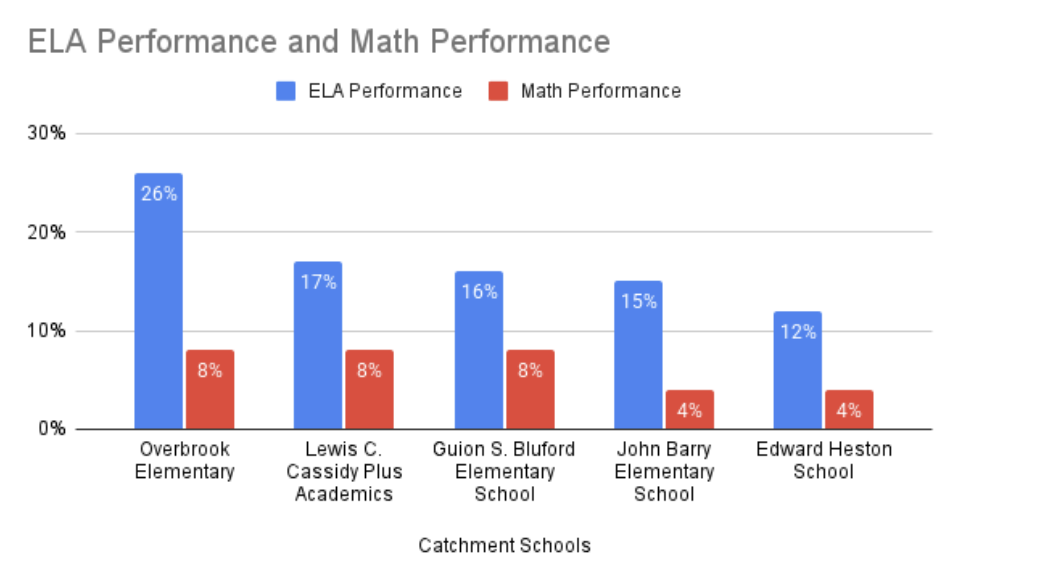
However, recent data on English Language Arts (ELA) and math academic proficiency provide a detailed insight into how Overbrook Elementary and the four other catchment schools compare. The statistics show that Overbrook Elementary is outperforming in ELA and matching in math academic proficiency.
Additionally, student and teacher attendance rates illustrate how Overbrook Elementary reports having higher attendance rates compared to the other catchment schools.

According to the district, Overbrook Elementary has a 78.8% utilization score and a “poor” program space alignment, or how well the school’s current physical spaces can support educational programs. Associate Superintendent of School Performance, Tomas Hanna, mentioned in a virtual community meeting that the closure decision was solely based on the facility’s space constraints.
“I need to reiterate that the recommendation was not a reflection of academic quality, but the access to higher performing academic programs at these receiving schools,” Hanna said.
Inella Ray is the director of advocacy and engagement at Children First, a non-profit that advocates for improved chances of students in Pennsylvania. She said the proposed closures are mostly due to a lack of funding. She said unlike other school districts in Pennsylvania who can raise property taxes, the school district of Philadelphia relies solely on federal and state funding.
“We are underfunded by $1.2 billion a year annually. So what does that mean for the kids?” Ray said.
According to the district’s plan, they will provide “$1 billion of its own resources and seek an additional $1.8 billion in public and philanthropic funding” to execute their strategy. Additionally, the proposal highlights that no teachers are set to lose their jobs.
The district claims that by closing schools in “unsuitable buildings,” they can prioritize “access to spaces, staffing, and resources needed for a comprehensive, high-quality PreK–8 teaching and learning environment.”
District data shows Overbrook Elementary currently enrolls 215 students, while its building could accommodate 250 students, hence its high utilization score. In contrast, the four catchment schools have significantly more unused space and can accommodate more students.
Notably, Edward Heston has the greatest capacity to accept more students, with John Barry, Guion S. Bluford, and Lewis C. Cassidy also operating far under capacity.

Changes in school locations could also come with possible transportation and safety concerns for students. Many of the students who attend Overbrook Elementary, as well as the other catchment schools, walk to and from school. With the proposed changes, students may find their commute to school to be significantly further.
The distance from Overbrook Elementary to the other schools ranges from 0.7 miles to 1.6 miles, or a 14 to a 32 minute walk. Many of the students in the neighborhood might live a distance from Overbrook Elementary, making this commute potentially even longer. This longer commute could also make the walk more dangerous for students walking far distances unsupervised.
While many parents walk their students to and from school currently, they may not have time to walk an additional half hour each way. The district has stated that students who are more than 1.5 miles from their catchment school will be able to be bused in.
For students walking, road safety in these newer areas is also a concern. In the evening of September 26th, 2024, a 14-year-old student from Lewis C. Cassidy Plus Academics School was killed in a hit-and-run on the 6500 block of Haverford Avenue. Though this happened in the evening, safety and distance are still concerns for all K-8 students.
Ray said that safety is about more than traffic control, “From my vantage point, safety also means being in a neighborhood that is familiar. You have people you know and people that will look out for you.”
Philadelphia Neighborhoods journalists walked to two of the catchment school locations during dismissal time. A few parents waited in cars for pickup while most students walked home.
Overbrook Elementary was proposed to close at the Philadelphia School District’s Board of Education meeting on Thursday, Feb. 26. A town hall will be held on Thursday, March 12 to hear feedback from the public regarding the Facilities Master Plan and its potential impact on their communities. The school board has not yet set a date for the final vote.
I thank you so very much for your comprehensive expose that that clears the smoke and shatters the mirror of perceived care and concern for high performance standards, excellence, stability in mental health, and basic human compassion for children and families that the School District of Philadelphia repeatedly and fraudulently represents itself as. God Bless You All fir caring about our children and justice through the truth! You didn’t have to do it, BUT we are So GRATEFUL that you did!