

By: Jocelyn Pappas and Jocelyn Hockaday
This article is part of an ongoing collaboration between Temple University’s Community Centered Journalism Capstone, Overbrook West Neighbors, and Resolve Philly. Through community reporting, the project seeks to understand the information needs of the Overbrook community, and what is at stake when a community school gets closed.
The proposed closure of Overbrook Elementary School is creating uncertainty for students, teachers, and support staff who rely on the West Philadelphia school’s resources and autism support programs.
For Nakia Daniels, an autistic support teacher at Overbrook Elementary for kindergarten through second grade, the biggest concern is how her students would adapt to a new environment.
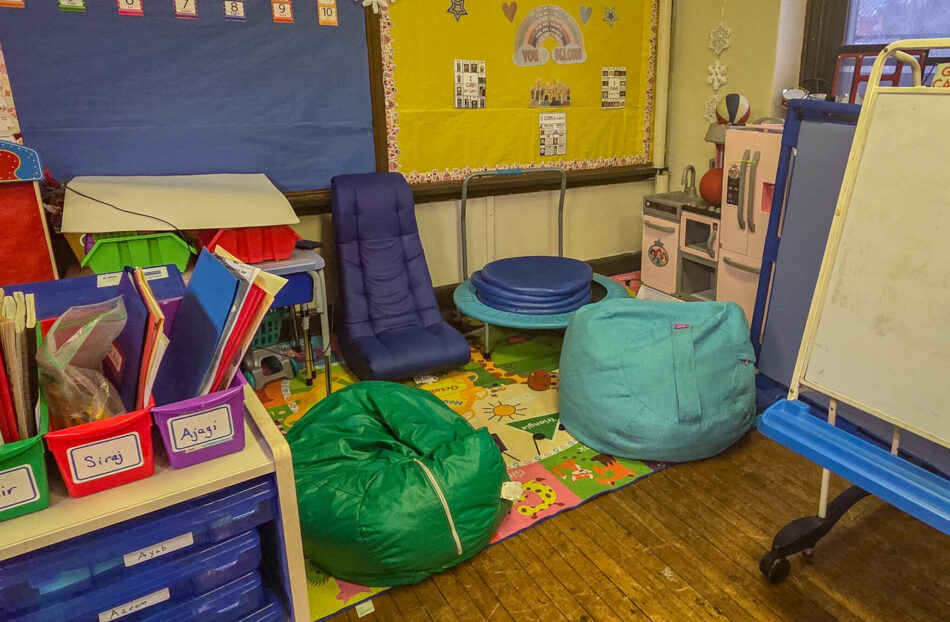
Daniels said she has worked with children with special needs for 30 years, two of which were at Overbrook. She said many of her students depend on structured routines and specialized classroom spaces, including a designated “stimming” area and access to noise-canceling headphones.
Autism support classrooms are typically designed to provide smaller staff-to-student ratios, sensory-friendly spaces and consistent daily routines that help students regulate behavior and communication needs.
A move to a larger school, Daniels said, could also create safety concerns for students who are known as “elopers,” children who may wander or run toward distractions.
“Can you really get 700-plus kids out during a fire drill in two to three minutes?” said Daniels. “Right now, we do well with the 200 kids we have. How are you going to do that with over 700 kids?’
The transition to other schools is another concern. Daniels questioned how families, particularly disabled parents or grandparents would manage longer commutes if students are reassigned.
Daniels noted that reassignment schools like Heston are a 20-minute walk away for an able-bodied adult. “Can you imagine how long it would take a disabled parent and or grandparent and a child just to get there.”
According to the district’s facilities plan, Overbrook students would be reassigned to one of the following schools: John Barry Elementary, E.E. Rhodes Elementary, Edward Heston Elementary, and Guion S. Blueford Elementary.
When those environments change, educators say students who rely heavily on routine may experience disruptions in learning and emotional regulation, especially if specialized classrooms or familiar support staff are no longer available.
Autism support programs have become increasingly important in schools as diagnosis rises across the nation. About 1 in 31 children in the United States has been identified with autism spectrum disorder, according to the Centers for Disease Control and Prevention’s (CDC) Autism and Developmental Disabilities Monitoring Network.
For students with autism, consistent routines and proper support are critical, including staff at schools like Overbrook that help regulate them.
Denise Fladger, a retired educator who spent over four decades with the School District of Philadelphia and now substitutes through Substitute Service Educational Support Team (ESS), said working at Overbrook has been meaningful.
“It’s been a blessing for me,” said Fladger. Assigned to the autism support classroom and working closely with students, Fladger said the one-on-one structure is critical.
“We assist the children one-on-one, which is the best thing, because of their needs and what they require,” said Fladger.
As the possibility of closure lurks, Fladger said her focus remains on the students and notes how it would be a detriment to tear that away from vital services.
“I’m here today to support the children because like Ms. Daniels said, they don’t have an alternative at this point,” she said. “The speech therapists come in. They have someone come in for orthopedics. So they get a lot of services that I don’t see throughout the city.”
She also emphasized inclusion within the school community, saying students in the autism support classroom are not separated from their peers. She said daily interactions during lunch and prep period allow them to build social connections and feel part of the broader student community.
“They mix with the other children when they go to lunch. They sit with the other children, so they’re not always isolated,” said Fladger. “The other children integrate with them. They all treat them as one.”
The Philadelphia School Board will hold a town hall meeting on closures on Thursday March 12 A final vote has yet to be scheduled . Until then, staff and faculty in collaboration with parents and other community members are pushing to retain the school, especially for children who are in the most vulnerable positions.
Be the first to comment