

“It was cold as hell,” Andrew Saltz remembers.
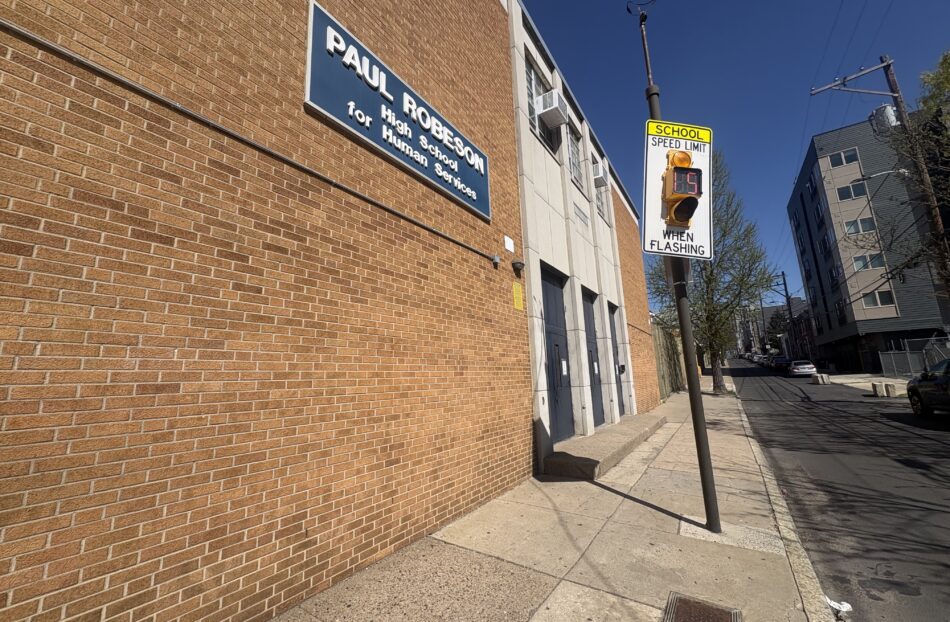
It was January 2013, and the School Reform Commission had just announced a sweeping plan to close dozens of Philadelphia schools, including Paul Robeson High School for Human Services, a small high school in University City.
Saltz, then a relatively new teacher, walked down Market Street alongside dozens of his students, colleagues and community members, heading to University City High School for the final meeting that would determine which schools would be shut down.
“The meetings were all pretty dramatic leading up to the final one,” Saltz said. “But the one that always takes me is the meeting at University City High School.”
Somewhere along the one mile route, the West Powelton steppers drum squad joined them, turning the protest into something louder, more visible, and harder to ignore.
When they arrived at the final meeting, students, teachers, and parents spoke for hours until a final decision was made. After weeks of organizing, student speeches and late nights, Robeson was spared.
Now, more than a decade later, Robeson is once again on the chopping block. But Saltz says that this moment feels different.
“I just feel very old and very tired,” Saltz said. “Here we are again.”
A school that already fought to survive
Now, Robeson is once again on the chopping block, this time as part of the School District of Philadelphia’s sweeping $2.8 billion Facilities Master Plan, a 10-year proposal announced on Jan. 22 that would reshape schools across the city. The plan initially called for closing 20 schools, but has since been revised to 17, alongside six school co-locations and more than 150 building modernization projects.
District officials say the plan is meant to address aging buildings, uneven resources and enrollment shifts across the city. But advocates argue that it would also displace thousands of students, more than 4,500 by some estimates, and fundamentally change where and how students learn.
Under the proposal, Robeson would close and its students would be relocated to Motivation High School, part of a broader effort to consolidate under-enrolled buildings and redistribute resources.
For parents like Wahida DeLoach, the uncertainty is not just about policy, it’s personal.
“What Robeson has done for my child’s self-esteem is second to none,” Delouch said.
DeLoach has a ninth-grade daughter, Ariana DeLoach, who she says thrived socially and academically when she enrolled at Roberson after previously being homeschooled.
“There is a little magic in this building,” Saltz said.”I do not want kids to lose that magic they have here.”
A different fight this time
In 2013, Philadelphia underwent one of the largest waves of school closures in U.S. history, with 24 schools shut down due to budget deficits and declining enrollment. The closures created long-term ripple effects: overcrowded receiving schools, longer commutes, and destabilized neighborhoods, according to a 2019 study by Economics Education Review.
Sarah Cordes, a professor of education policy at Temple University who studies school choice and mobility, said studies on Philadelphia’s 2013 school closures found largely negative outcomes for students, including declines in academic performance, attendance and behavior.
“School closures just tend to be pretty disruptive and detrimental to their outcomes,” said Cordes. “This isn’t just a temporary thing. It seems to be long-lasting.”
Those effects, she said, were not limited to students whose schools closed. Students in receiving schools also experienced disruptions, particularly when large numbers of displaced students were absorbed into already strained environments..
Robeson, however, became one of the few success stories to emerge from that era. After avoiding closure, the school worked to rebuild its reputation. A 2017 report from The Philadelphia Inquirer described Robeson as one of the city’s most improved high schools, citing gains in attendance, graduation rates and student engagement.
For teachers like Saltz, that history makes the current proposal harder to accept.
“We’ve done this before,” he said. “We fought it before.”
A plan filled with uncertainty
Saltz says that In 2013, opposition to the School Reform Commission gave students and educators a clear target. Today, decisions rest with the locally controlled Philadelphia Board of Education, a shift that he says has complicated organizing efforts.
“Last time, you kind of had an enemy,” Saltz said. “This time it’s the school board and it’s been tough to really find one.”
Wahida DeLoach said that when she heard about the proposed closure she felt disheartened.
“She loves her teachers, and she just feels very safe when she enters that space,” DeLoach said about her daughter who had only been at the school for five months before hearing about the school closure. “Robeson is a family.”
The concern extends beyond academics to safety and stability. DeLoach said the proposed reassignment to another school would mean a longer commute and a less familiar environment.
“It offers a measure of uncertainty as a parent,” she said. “There’s so many things to contend with. Why do I have to worry about where my child is going to be educated?”
“The only moral stand is to vote no.” Community members respond during April 23 meeting
On April 23, the school board held a meeting in which they were expected to officially announce the final version of the Facilities master plan, including their final decision about school closures. Instead, hours before, they announced that they would postpone that final decision to April 30.
The meeting that followed at the School District of Philadelphia headquarters drew a packed room of students, parents and educators, many of whom were wearing school colors or holding handmade signs in opposing the school closures.
Speakers lined up along the walls, waiting hours for a chance to speak.
Lisa Haver, a retired Philadelphia teacher and co-founder of the Alliance for Philadelphia Public Schools, a grassroots advocacy organization, spoke at the meeting and criticized the district’s facilities plan and the way it has been rolled out to families and communities.
“The plan makes no sense. It has no financial projections and it’s based on imaginary funding,” Haver said. “The only moral stand is for this board to vote no.”
For students like Ariana DeLoach, the moment was both nerve-wracking and urgent, an opportunity to speak directly to the people deciding the future of her school.
“Do you know what it feels like to finally find a place where you belong, and then be told it might be taken away?” she said.
Ariana said the school’s small size and supportive environment helped her grow not just academically, but personally, something she fears losing if the school closes.
“Before I came to this school, I got straight F’s. Now I get straight A’s,” Ariana said. “My teachers are like second parents to me.”
City leaders were also present at the meeting, and pushed back on the proposal, arguing that closures alone will not solve deeper issues within their districts.
Jamie Gauthier, who represents district 3 covering West and Southwest Philadelphia where Robeson is located, said the district should invest in schools rather than eliminate them.
“We cannot close our way to a better school system,” Gauthier said. “Our students deserve real investment, transparency and a plan that actually supports them.”
What’s at stake
Inside Robeson, the uncertainty is already shaping daily life.
Saltz said fewer students feel deeply tied to the building, a change that has made organizing more difficult this time around.
Still, he says that the school continues to be a place where students who don’t quite fit elsewhere, can find stability and build relationships that extend beyond graduation.
“I like to call this place the Island of Misfit Toys.’ Saltz said. “You go somewhere else, and you’re just a number.”
Today, the school serves roughly 250 to 300 students, the majority of whom are Black. About 80% of students are considered economically disadvantaged, and the school operates with a small enrollment compared to other district high schools.
Despite academic challenges, including lower math proficiency rates, Robeson’s graduation rate has reached as high as about 95%, exceeding the state average.
The Board of Education is scheduled to meet today to vote and present their updated plan. After years of fighting to stay open, this vote could close the 53 year old school forever
When asked what she would say to district officials Delouch said simply, “Please do not take this away from us.”
The school closure would mean a major change for her: she says that if the school closes, she would consider homeschool for her daughter.
“I don’t want to do it, but I will,” DeLoach said. “Because I’m not sending her somewhere where she feels like just another number after everything she’s gained here.”
Be the first to comment