
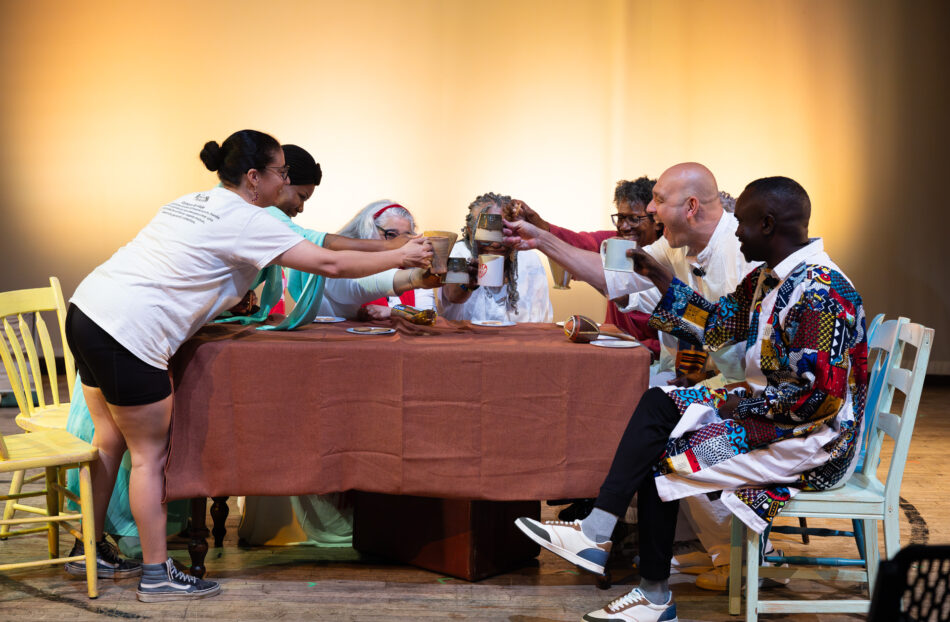

Eight people are sitting around a table that is set with plates and mugs. “Cafecito, anyone?” says a woman seated near the middle, wearing all white with a red sash.
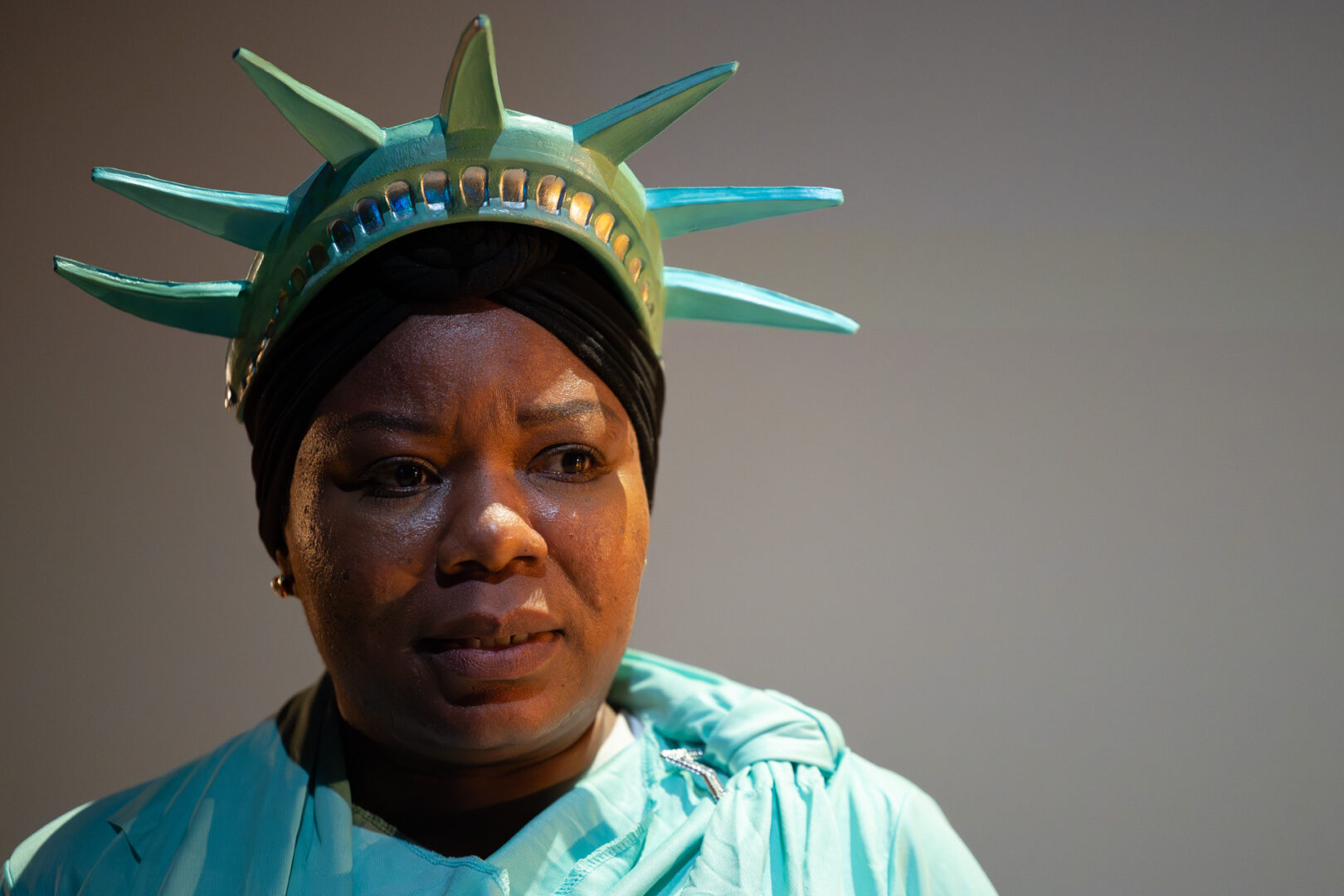
The group includes a man wearing a Baye Fall cloth, a woman wearing a seafoam green Statue of Liberty dress, and another wearing a Temple University sweatshirt. They answer “Sí, sí,” and “Yes, please.”
As one person pours and distributes the coffee, the others break into their own conversations. Though the group is diverse, with people from many different races and ages, there is a sense of familiarity.
As the low chatter dissolves into silence, the woman in white lays out a question: “What does it mean to be here?” It is as much for the audience of the scene as the group of people on stage.
The woman was writer and artist Magda Martinez. Alongside fellow artist Lynda Grace Black, the two created “To Be Here.” The “community-rooted” multimedia performance and art exhibition was produced by Journey Arts at the Christ Church Neighborhood House in Old City, Philadelphia from June 11-13.
“The way that we show up in the world, we’re a collection of stories,” said Martinez about the project. “[There] are examples of those hundreds and thousands who came before us and will come after us. We are ‘the now.’ What’s happening now?”
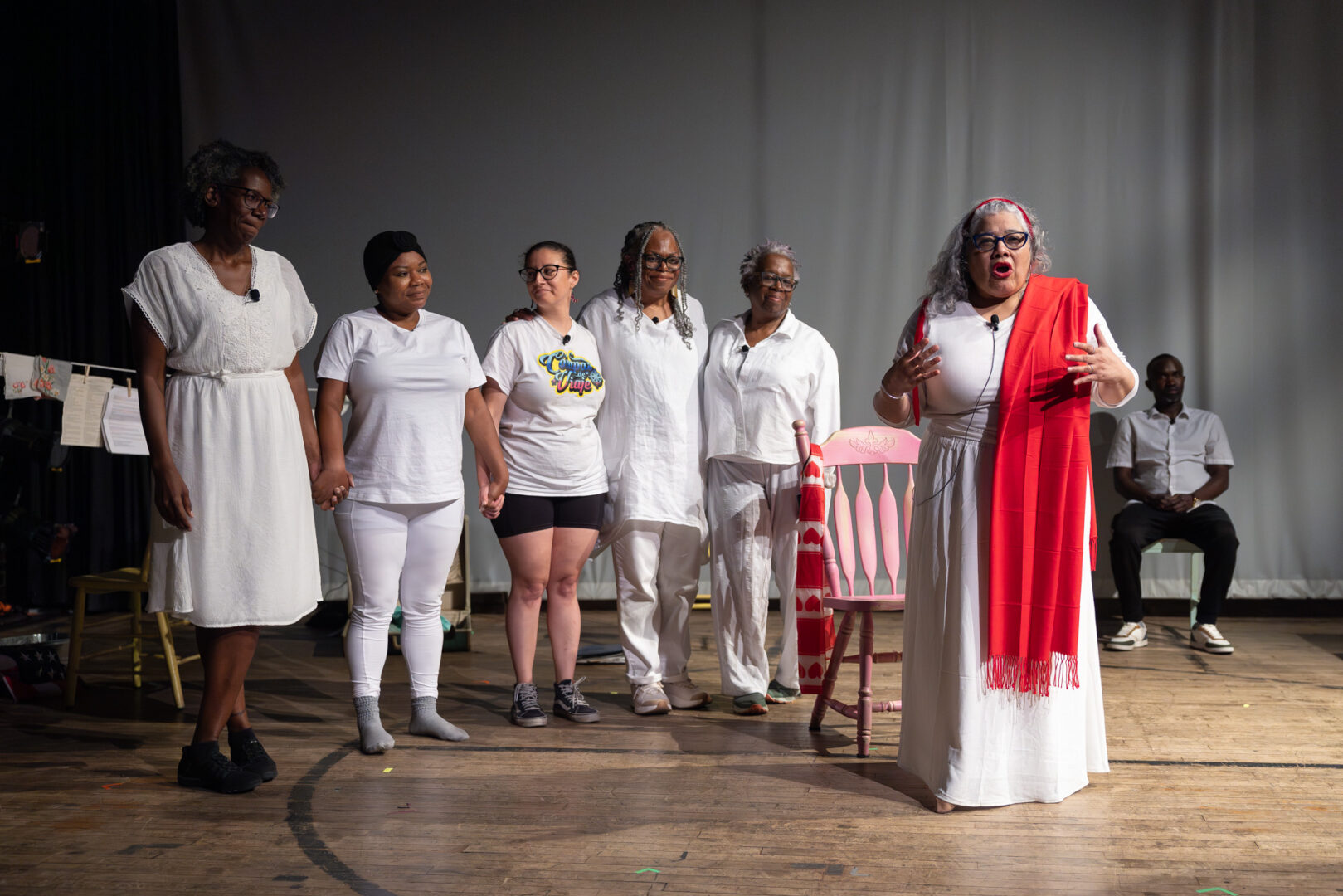
Unlike traditional theater and art galleries, the cast was not made up of experienced actors and artists, but of Philadelphians from a variety backgrounds, each with a story to tell. Hailing from Nicaragua, Puerto Rico, Senegal and Philadelphia, the play offers a version of American history as told through a patchwork of community stories.
Performances took place on the precipice of America250, a nationwide celebration of the 250th anniversary of the signing of the Declaration of Independence, which took place just three blocks from the production’s venue.
To Be Here stands in stark contrast to the celebration of the nation’s semiquincentennial, which was rebranded by the Trump Administration as Freedom 250 and critics say celebrates a whitewashed version of American history and uplifts a Christian nationalist view of the American identity.
How “To Be Here” came to be
When Lynda Black saw an open call from Journey Arts, a nonprofit performing arts organization based in Philadelphia, seeking artists to create pieces inspired by a central theme of “movement and migration,” she reached out to Martinez with the intention of collaborating.
Black is the daughter of one of the first Black families to inhabit Mt. Airy. Martinez is the daughter of Puerto Rican immigrants. Both had plenty of experience with the proposed theme.
The two put out an open call themselves, looking for Philadelphians interested in joining a discussion group. Tamara Jiménez was brought into the fold by Martinez.
“It was a storytelling project,” said Jiménez. “[Martinez and Black] wanted to tell stories about people’s experiences from different backgrounds … what it means to be in the United States at this moment.”
The group of community members who would later form the ensemble represents a range of American experiences. Immigrants from several different countries, Black Americans with roots in the Great Migration and born-and-raised Philadelphians all answered Martinez and Black’s call.
They began gathering in April 2025. People shared stories that have marked their lives. Mariama Korka Diallo recalled getting lost on a SEPTA bus due to a communication barrier. Lynda Black remembered her father receiving a threatening postcard from a Mt. Airy neighbor in the 1950s. Rochelle Cooks retraced the path her ancestors took that led to her graduating from Temple University.
These conversations would eventually become many of the show’s monologues, but they began as a means of creating connection amongst the participants.
“Those meetings were like therapy sessions,” said Aliyah Gardner, a lifelong Philadelphian who participated in the project . “I have a new branch on my family tree.”
Initially, Martinez and Black had only planned for six sessions with the group. Quickly, the two realized something bigger had been set in motion.
With the help of Martinez and the production’s director Tanaquil Marquez, the discussion group turned ensemble edited their writings and conversations to fit the structure of a stage show.
Of the prompts given by Martinez and Black, one became a defining thread that connected the mosaic of experiences shared by participants: being here, in America, in Philadelphia, brought the group together. It was the basis of many discussions. “To Be Here” would be the title of the project.
“There’s ‘To Be Here,’ then there’s ‘To Be Here Now,’” said Martinez. “It was really important for people to feel empowered, like they were telling their story the way they choose to tell their story.”
“The lens of kids”: Realizations from a lifelong Philadelphian
One of the show’s first monologues was delivered by a woman donning a Statue of Liberty costume. A school bell sounded and Aliyah Gardner began describing her most important elementary school friendship: a friend who was originally from Cambodia.
“[We embraced] our cultural similarities and differences,” said Gardner. “Viewing one another through the lens of kids.”
She and her childhood best friend shared ramen packets and made boys chase them on the playground. They believed they could have been related, both with black hair and bangs, separated only by the English classes they took.
Initially, Gardner struggled to decide which story to tell. In the process of developing her monologue, Gardner went to dinner with Martinez. While discussing a few different angles, they ended up talking about the friendship.
“She started telling me a story about this girl, and I go, ‘Oh, so your first best friend was an immigrant?’” said Martinez.
“I was like ‘Oh my god, my first best friend was an immigrant and I didn’t even know it,’” said Gardner. “I didn’t think about it.”
Martinez told Gardner to go home and start writing. That night, Gardner lit sage and put pen to paper.
“It just started pouring out of me. That’s the best way to describe it,” said Gardner.
She laid out the difficult realizations she’s had about the country she once felt so proud of as that little girl with an immigrant best friend. Realizations of “250 years of lies told” and “a flag that betrays us.”
“That’s not the America that was taught to us as children,” said Gardner. “What a hurtful feeling.”
On stage, Gardner’s childhood reverie was jolted to the present with Gardner evoking images of families being separated and children losing friends. In one of the show’s most pointed political statements, Gardner led the ensemble in a chant of “ICE out.”
“Split in two”: The realities of an immigration story
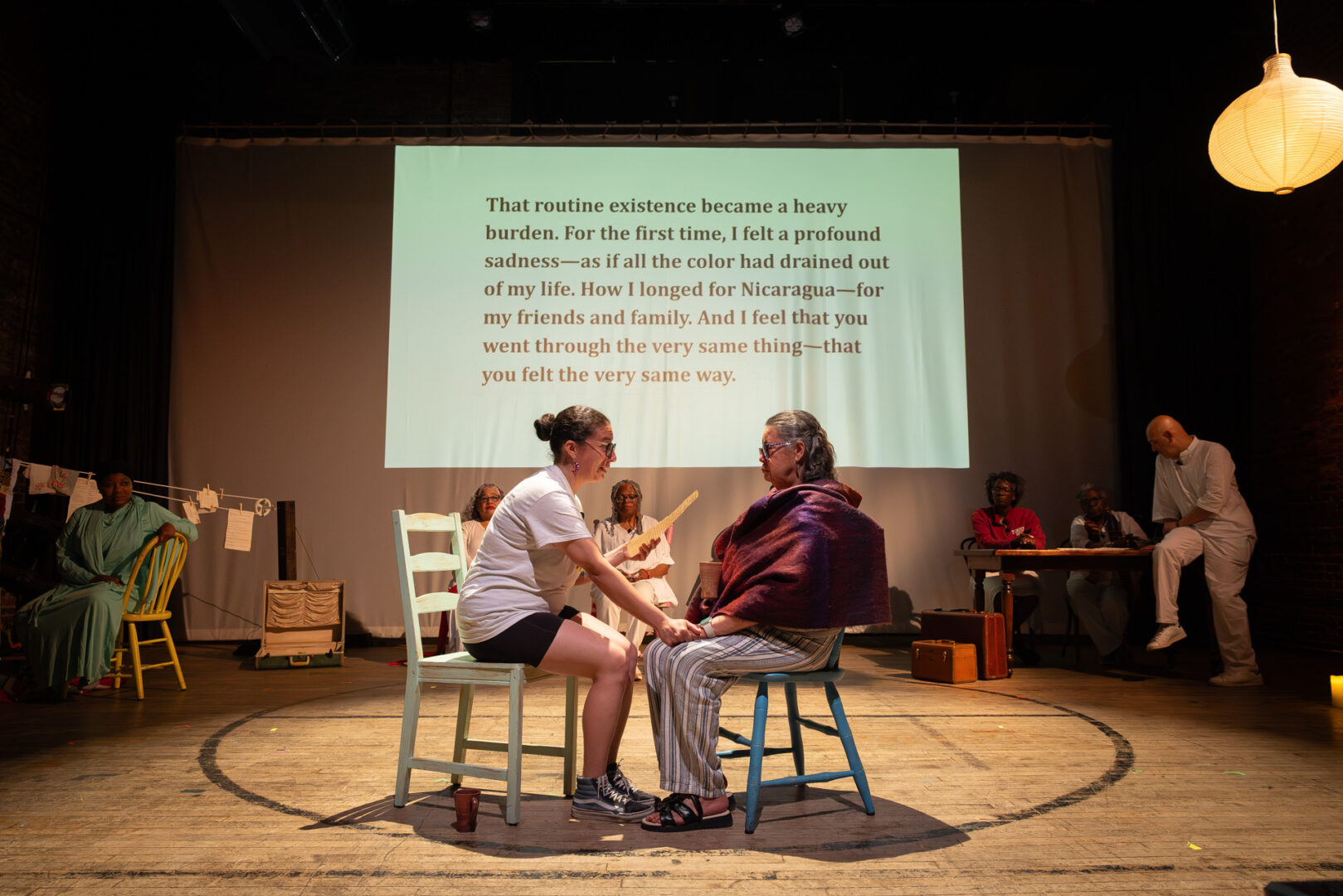
Tamara Jiménez came to the U.S. from Nicaragua, ahead of her mother, Dora, when she was 15 years old. When she first arrived in Philadelphia, it was the dead of winter. She still remembers how those cold days in “a strange place that felt utterly devoid of hope” began a period of “profound sadness,” one that would have a lasting impact on her relationship with her mother.
This would ultimately become the focus of her performance in “To Be Here.”
Jiménez said that she and her mother did not have a lot of space to express vulnerability in the 24 years they had been in the U.S. Initially, when she tried to write her monologue, she felt nothing was coming to her head. Until one day, inspiration struck in the form of a memory.
“I sat down and I started to remember seeing my mom when we were reunited for the first time,” said Jiménez. “I just started writing everything, everything, everything.”
She would eventually turn these thoughts into a letter to her mother.
During the final dress rehearsal before the show opened, Jiménez read the letter sitting face-to-face on stage with her mother for the first time. Both women cried. They would cry together, in front of an audience, for the next three nights.
In the letter, Jiménez explained the depression she experienced as a young woman, the burden of navigating her new life as an immigrant and the understanding that her mother had her own obstacles.
“It’s been 24 years since our mother-daughter relationship faced a series of challenges,” Jiménez wrote. “We kept our silence regarding how we truly felt.”
It ended with an admission: “Te amo mucho, Ma. Te amo mucho.”
“I wrote ‘We are in a moment, right now, that we’re getting to know each other for the first time.’ And it feels quite sweet to be able to do that,” said Jiménez.
The scene was the show’s emotional climax, as well as a moment of personal relief.
“All those years, imagine you’re wearing a backpack, and each day you’re putting a stone inside,” said Jiménez. “I feel like those three days, I was just taking the stones out of the backpack, one by one. And by the third performance I was like, ‘My shoulders, my back, they’re free.’”
“There is you”: Personal reflection in exhibition
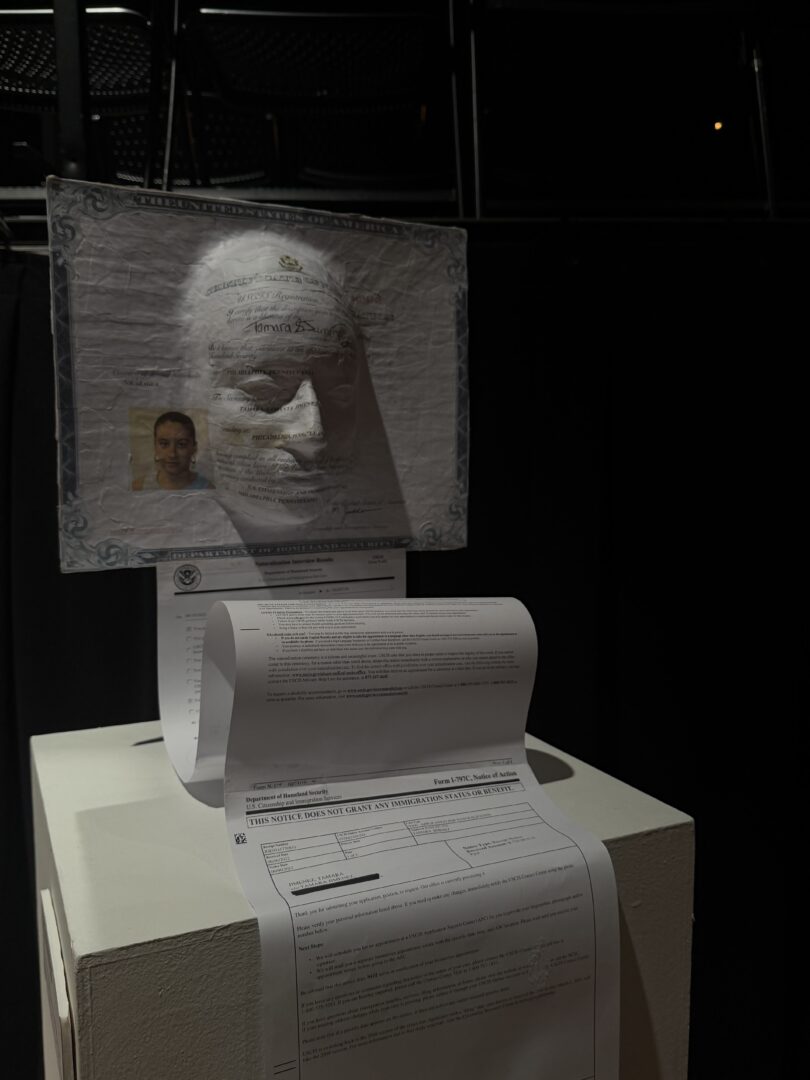
Jiménez also contributed a visual art piece for the exhibition: a paper maché mask of her own face adorned with immigration forms and documents. The piece’s title, “Fourteen Years in Three Hours,” was inspired by her first trip back to Nicaragua, a three hour flight after nearly a decade and a half in the U.S.
“When it comes to my piece, when it comes to immigration, it has become politicized. Sometimes we become sort of another statistic,” said Jiménez. “We need to present more stories that bring back the humanity in ourselves, to have a space where more people are able to do that.”
The exhibition turned the ensemble’s personal stories into visual art. On all three nights of the performance audience members wandered through the small gallery before the show, taking in each item. Some were abstract expressions, like Jiménez’s mask and Martinez’s skirt paneled with images of Puerto Rican history. Others were everyday objects, like a cast iron pan passed through generations and a Black dandy suit.
“In these specific stories, there is you,” said Martinez. “Somewhere in there is you.”
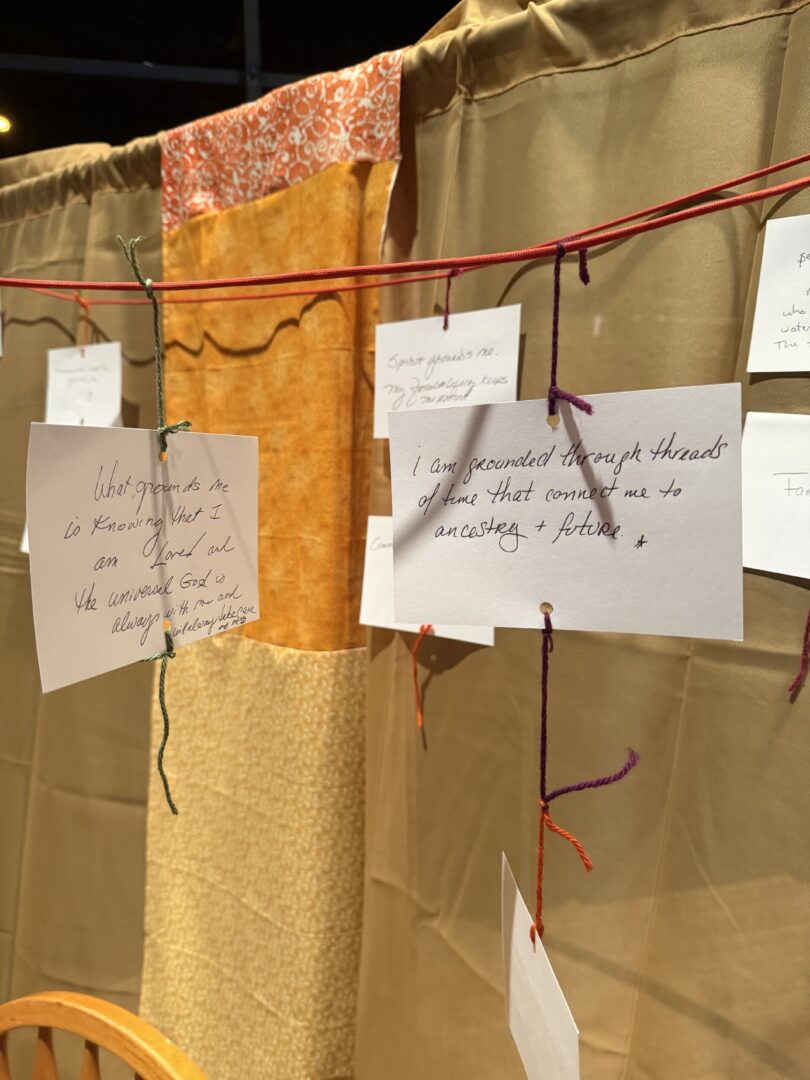
In the center of the exhibition, a small table surrounded by a curtain gave audience members a space to write responses to prompts inspired by the show.
One card read: “I am grounded through threads of time that connect me to ancestry and future.”
Another: “Community is my strength.”
There, among the pieces created by the “To Be Here” ensemble, the audience’s notecards were tied together in a display of their own.
Sounds like a wonderful project all around. Nice article.