
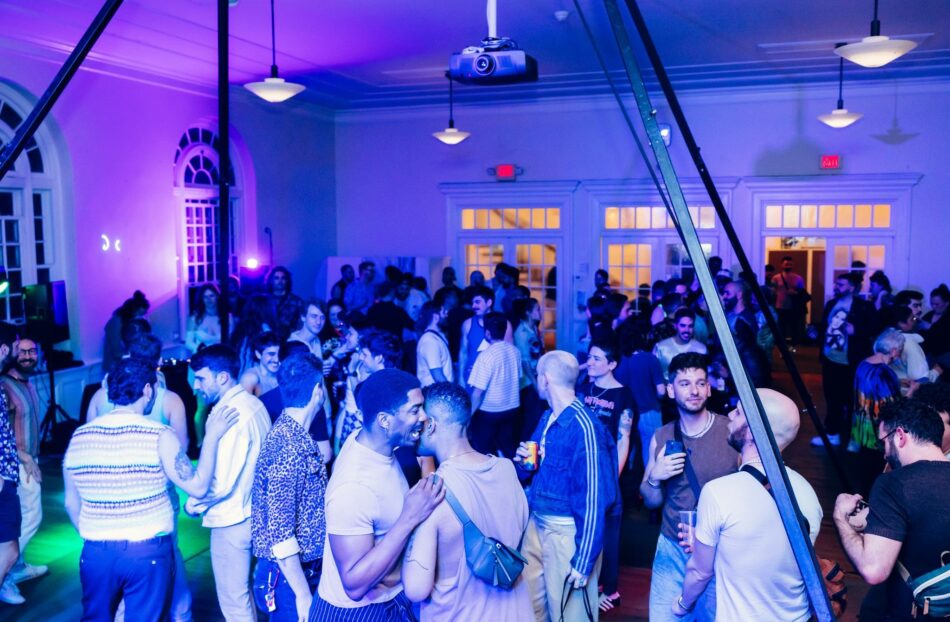

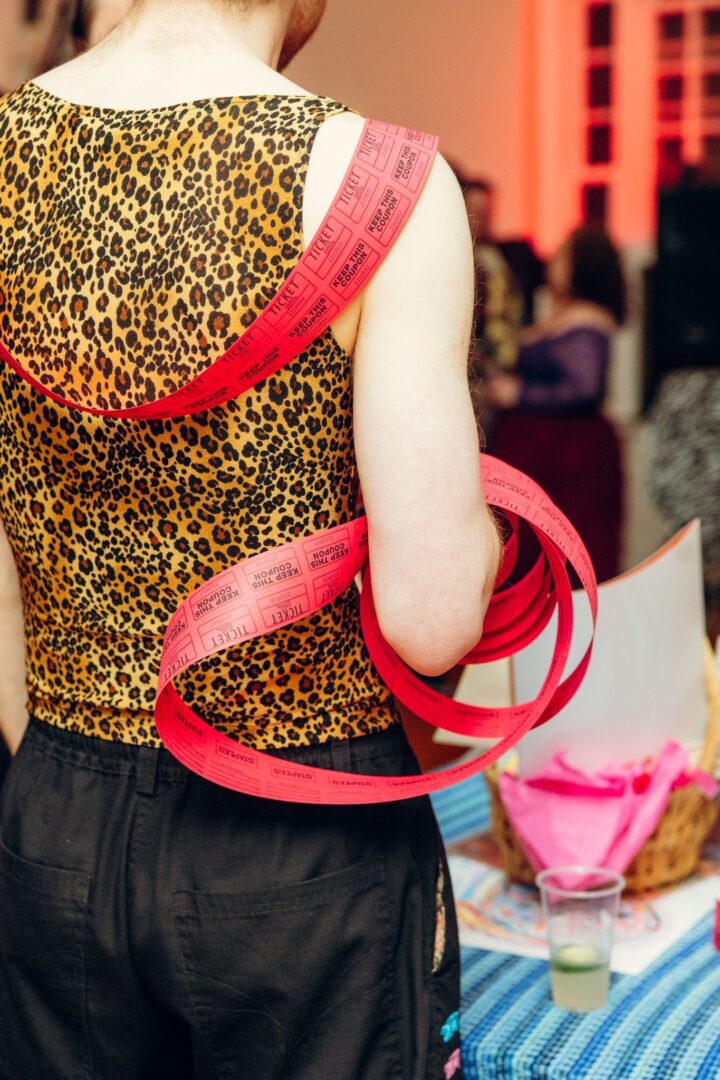
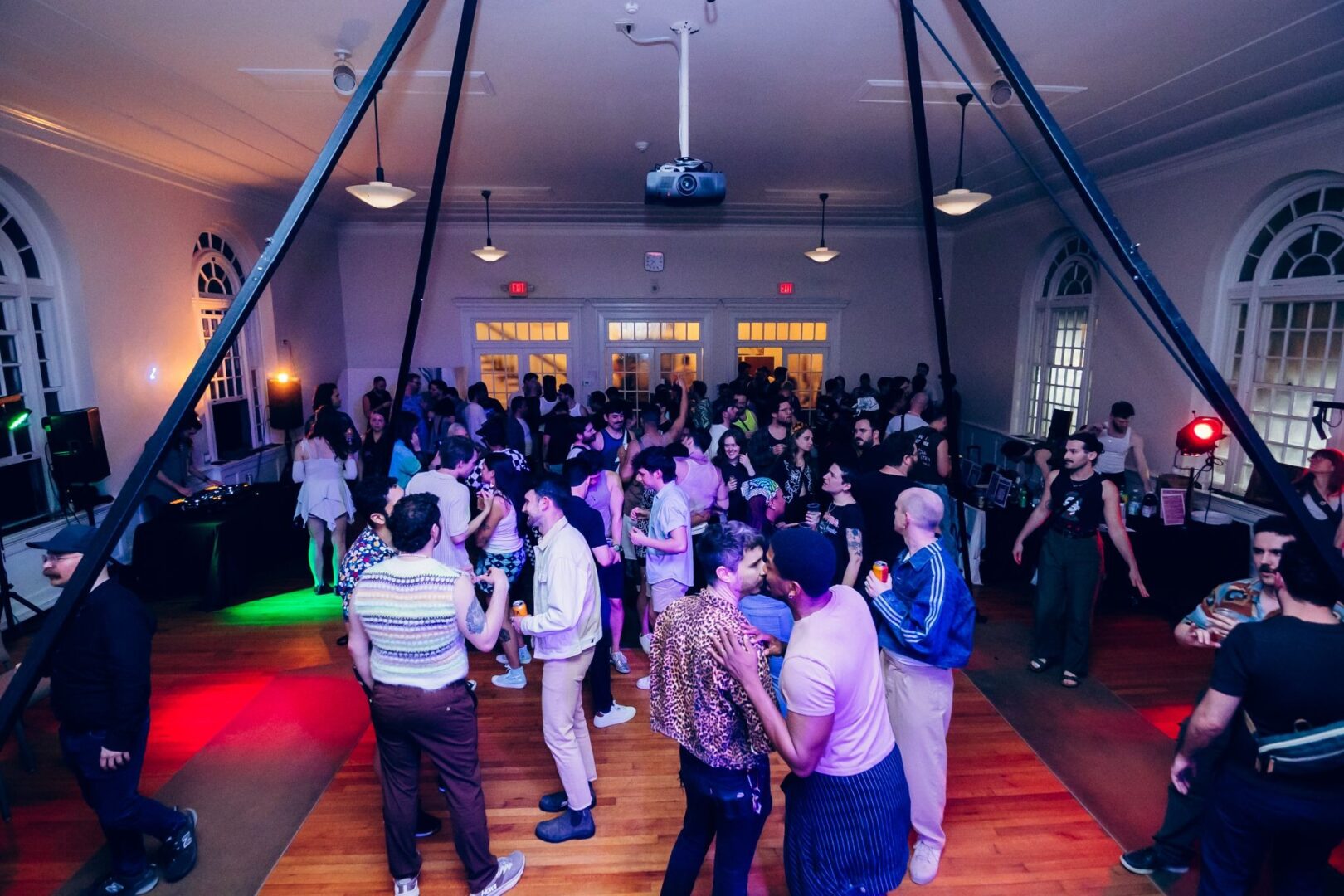
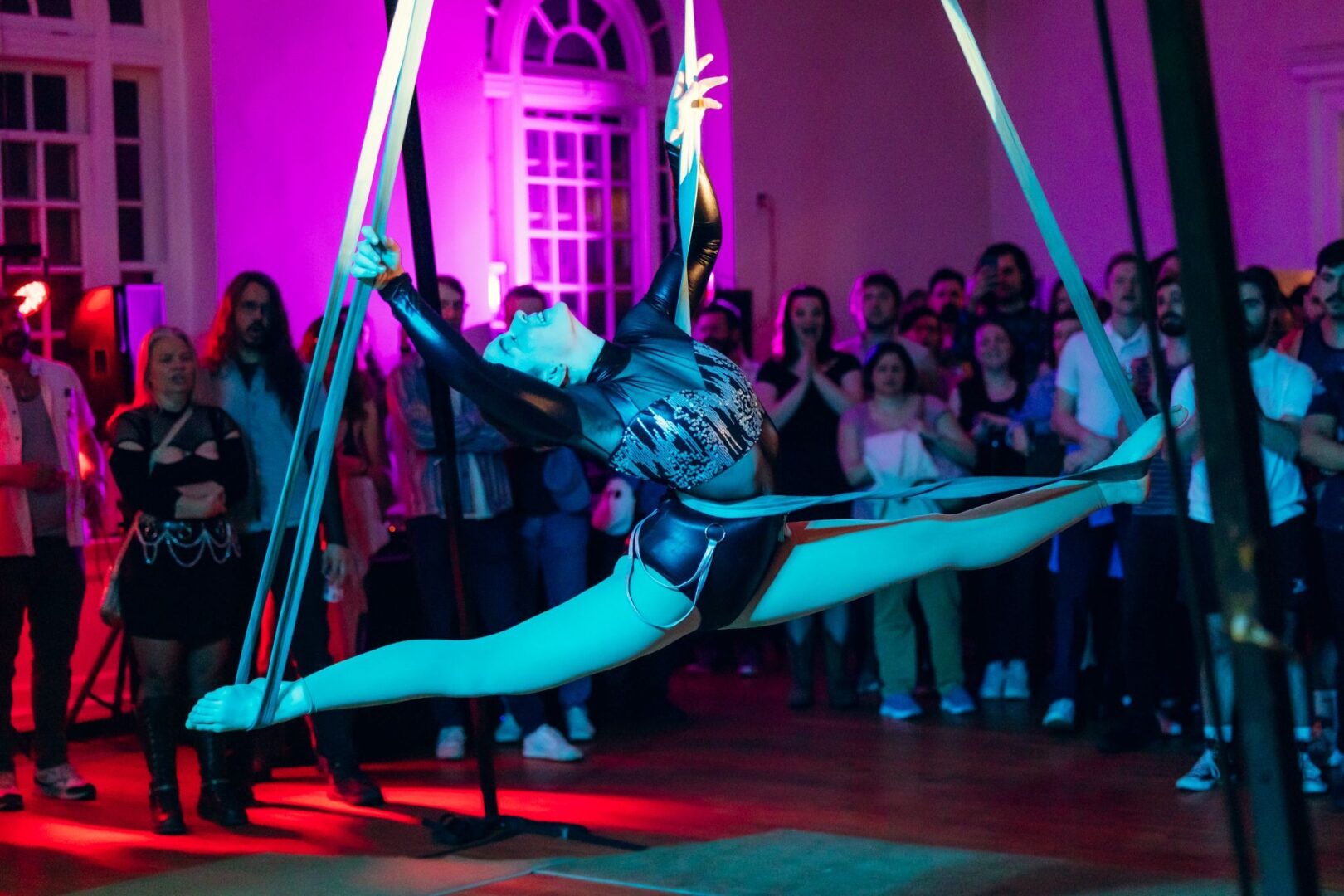
The Ethical Society’s high-ceilinged hall in Rittenhouse Square isn’t full yet, but it’s getting there. An aerialist is held above their partner’s head as they weave through the crowd before the main show begins. The drinks are pay-what-you-can with a suggested donation of $7. Organizers wrapped in raffle tickets work the room, while strangers approach one another and engage in conversation.
The room is loud with dance music. Political signs with handwritten messages like “Keep ICE Out of the Gayborhood” are hung throughout the space.
David Snelbaker stands near the entrance. He compares the night to something from 1997.
“It reminds me when I first came out, there was an ACT UP party,” David said. “[This party is] not as wild, but it reminds me of that.”
Fundy Volume III is the third event in a series of fundraiser dance parties thrown by Philly Queer Fundy, a self-described grassroots collective seeking direct action, mutual aid, and safety for Philadelphia’s queer community. Tonight, every dollar raised at the door, at the raffle table, from drink sales, and through donations will go to Asian Americans United and the Pennsylvania chapter of the National Domestic Workers Alliance—two immigrant rights organizations in the city.
By the end of the night, 187 people will raise $9,400.
Despite raising thousands of dollars in a single night, Philly Queer Fundy did not begin with a strategic plan or a 501(c)(3). It began with a book.
“What can we learn from their bravery?”
Soon after Trump entered office for a second term in early 2025, a small group of queer Philadelphians started gathering in one another’s houses for an informal book group. Feeling threatened by current political institutions, they wanted to learn from queer movements of the past to help navigate the present.
The book they discussed was Sarah Schulman’s Let the Record Show: A Political History of ACT UP New York, 1987-93, an 800-page oral history of the ACT UP activist group that upended the American healthcare establishment’s response to the AIDS crisis.
“We were all feeling like we were in this moment of danger and destruction and death,” said Glen Forster, one of the collective’s original organizers. “The queer community was under attack in so many ways—as immigrants, as trans folks, as people of color—and our queer institutions weren’t doing anything.”
Forster said that the book club grew out of overlapping social networks. Some people were invited in by friends, others came in through the Philly Queer Book Club, a monthly meeting at Giovanni’s Room.
At the time, Forster said the reading group found themselves in a political climate that felt deeply unstable.
“We really felt like the queer community was under attack,” Forster said. “Hundreds of millions of dollars had been spent on insanely harmful anti-trans ads. ICE was disappearing people. A lot of queer folks, when they get sent back to where they came from, have to flee because they are queer. Being sent back is like a death sentence.”
The friends asked themselves what ACT UP’s members had asked themselves in the 80s: what are we going to do about it?
“I think we were really looking back at our ancestors,” Forster said, “[We were looking] at what folks in ACT UP were able to do, and asking: what can we learn from their bravery?”
What they could do, it turned out, was throw a party.
“We’ve all had some experience planning parties before, and we have friends that we know can do this,” said Dylan Leahy, one of the organizers. “The idea was to politically activate groups that maybe weren’t as politically engaged, especially in party spaces, and try to find a way to bridge that sense of community and fun and joy, but also with a broader purpose of mutual aid.”
“Solidarity is survival”
The first Fundy, held in May 2025, was in a private South Philly event space. It raised $5,900 for a mutual aid organization supporting trans women in West Philly. Ninety-five people came.
“What was so cool was that it was a really fun party,” Leahy said of that first event. “There were a bunch of cool performers, an incredible DJ, and the energy felt electric. But that was paired with political action. People spoke from the mutual aid group and explained where this money would go and why it was so important. One of our organizers got up and talked about that history, that lineage that we see ourselves as part of.”
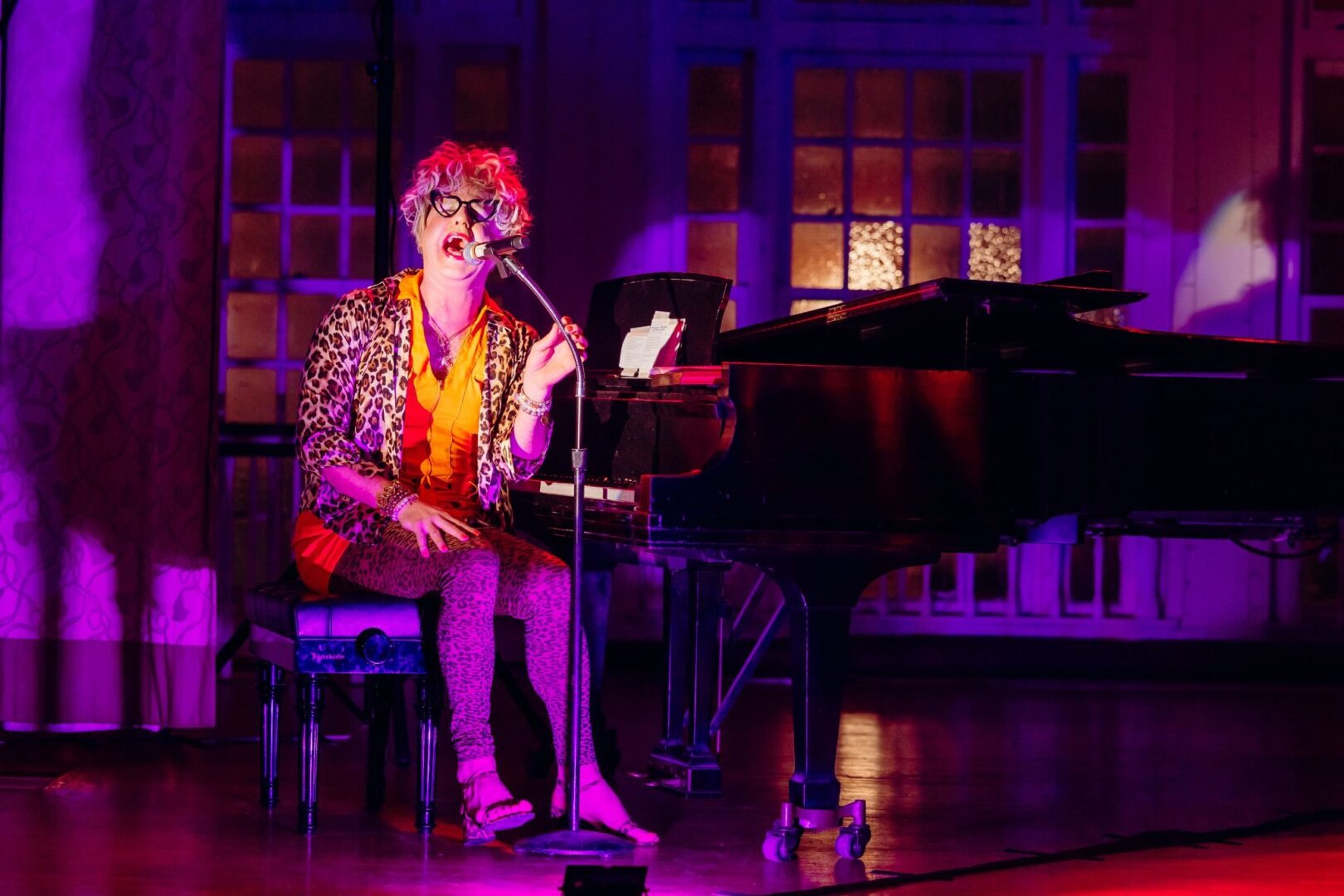
Volume II, in October 2025, was at the William Way LGBT Community Center. It drew 183 people and raised $11,400 for Pride Asylum House, a Philadelphia nonprofit that provides housing and legal support to queer asylum seekers. For Volume III, the collective added performers mingling in the crowd before the main show, a raffle, and a new venue.
They also shifted their beneficiaries toward organizations offering ICE response trainings. These trainings teach businesses and community members their legal rights and what steps to take when encountering Immigration and Customs Enforcement.
The decision about where the money goes is collective. At monthly organizing meetings, members propose organizations and vote. Leahy, who handles communications and social media, also helped lead ICE Out training for gay bars and businesses like Giovanni’s Room and Philly AIDS Thrift.
Jonathan, an attendee who requested anonymity, says that Fundy Volume III feels different compared to other events.
“It feels more social to me,” Jonathan said. “When I think of queer bars and gay bars, nobody talks to you. But here, everyone is talking to you.”
For Leahy, joy and mutual aid aren’t separate concerns.
“With the way the political climate is, it doesn’t always feel like a great time to be a queer person in America,“ Leahy said. “For much of my youth, it felt like there was a real sense of momentum, like we were moving forward as a queer community, more rights were being enshrined, and discrimination was hopefully on the downturn. I feel like for young queer people today, it might not actually feel like that anymore.”
Leah said that while a dance floor is not a solution to political precarity, it’s where the muscles for collective action can be built.
“The same muscles you get from organizing an event like this—meeting new people on the dance floor, making connections—those are the same muscles we’re going to need to protest, to do political action,” Leahy said. “For us at Philly Queer Fundy, we see these as very much related causes.”
Jonathan put it more simply.
“We all do fun things,” he said. “We might as well organize in a way that’s mutually beneficial. Build community through that. Make connections instead of going to bars with the same three people we know and staring at our phones.”
In its first year, the collective trained seven gay bars on ICE response protocols and raised more than $26,000 across three events for organizations working directly with Philadelphia’s immigrant communities, trans residents, and queer asylum seekers.
Fundy Volume IV doesn’t have a date yet.
In response to her novel inspiring the organizers behind Philly Queer Fundy, author and former ACT UP member Sarah Schulman said in a comment: “It is amazing that my work was able to help people move forward in any way. That’s what we all dream of.”
“Even if Philly Queer Fundy isn’t the exact organization for you, let our success just be a way for you to see that it can be as simple as just coming together and making something happen,” Leahy said. “Which is so cool to me. It feels very specifically queer, somehow. That sort of ‘okay, these are people that came before us, so what can we do to replicate what they did?'”
Philly Queer Fundy can be found on Instagram and through their Linktree. Those interested in getting involved, attending future events, or learning about ICE Out trainings can sign up for the mailing list through their social media profiles.
Be the first to comment