ABOVE: Gretchen Shanfeld (left), director of Health and Wellness at the Nationalities Service Center, and Cathy Jeong stand in front of a tapestry created by 30 immigrants from Bhutan, a country in the Himalayan Mountains. The tapestry, which is about 10 feet long, details some of the country’s culture and was made in a group-art-therapy program in PPR.
The Philadelphia Partnership for Resilience started as a small torture survivors support group in 2009, but was able to expand in 2013 thanks to funding from the United Nations. Today, 90 clients and their families are part of the program. The group seeks to help survivors of torture gain access to legal and social services, and recover in group settings.
About 3,000 torture survivors live in the Greater Philadelphia area, according to HIAS Pennsylvania, a PPR partner that provides free legal services to clients in the program. PPR screens about 600 people a year for a history of torture.
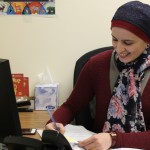
Zainab Alsawaf, a case manager in the Philadelphia Partnership for Resilience, makes a note on a file at her desk. Alsawaf, who can speak English and Arabic, is one of three case managers in the PPR program who help clients navigate recovery options and can refer them to a variety of legal and social resources.
Most clients in PPR are also enrolled in other programs at the Nationalities Service Center. Those programs can help families settle into new homes, bring relatives from abroad to the U.S. and help obtain legal work authorization. The center accepts clothing and housewares donations, which are packaged and given to families who are resettling in America.
Alsawaf (left) and Jeong hold two “before and after” portraits, which were created by torture survivors in group art therapy programs. In those programs, PPR brings in an artist, who pitches a theme and helps the clients envision the work they want to create. Art created by PPR clients hangs on the walls of the NSC. “Toward the end [of sessions of art therapy] they feel connected and less isolated,” Jeong said.
Alsawaf, who now lives in the Far Northeast, came to Philadelphia eight years ago as a refugee from Iraq. “I have been resettled by this same agency here,” Alsawaf said. She often tells her own story upon meeting a client, to show that she can relate. Once she opens up, “a connection happens,” she said.
The NSC has a separate closet just for housewares donations. Besides clothes, the NSC also accepts pots and pans, dishes, silverware and sheets.
“Our long-term goal and purpose of our program is to help them be on a path toward healing,” said Cathy Jeong, shown here in her office.
Once in the program, clients can get involved in several group activities aimed at restoring a sense of identity and overcoming fear that torturers have induced. Completed projects from the group art therapy sessions hang in the Nationalities Service Center‘s offices near 12th and Arch streets in Center City. PPR also offers coordinated social outings, educational opportunities and a new group campaigning for human rights.
Click through the gallery above for more information about the Philadelphia Partnership for Resilience.
This Vimeo content is blocked because marketing cookies are disabled.
Since November 2016, SEAMAAC has partnered with other organizations that work with Philadelphia’s immigrant and refugee populations to rebuild Mifflin Square Park, located in South Philadelphia at Sixth and Wolf streets. In collaboration with organizations
Elvis Almanzar, a psychology major at Temple University, sported a maroon and yellow Puentes de Salud T-shirt. From Reading, Pa., Almanzar is tied into his senior year which will end with him receiving a certificate
In response to President-elect Donald Trump’s promise to end the country’s refugee resettlement program shortly after taking office, Philadelphia mayor Jim Kenney signed an open letter requesting President Barack Obama and his administration to continue to protect
Temple University uses cookies and similar technologies to enhance your browsing experience, understand how our websites are used, and improve our services. Some cookies are necessary for our websites to function, while others help us analyze website traffic. By clicking "Accept All," you consent to our use of non-essential cookies.
Global Privacy Control is turned on in your browser. You do not need to change anything. Necessary cookies stay on; preferences, analytics, and marketing cookies plus some videos and embedded content will stay blocked. To allow them, turn GPC off in your browser and reload this page.




Be the first to comment